Built around the way a school year really runs.
Four terms, a team that's already full, and a plan the board is about to sign off. Planning Room puts hours and names against that plan, so the principal and the board can see whether the year can hold it.
One question for the next board meeting.
"Which term next year is the heaviest, and what else is happening in the school that term?"
It takes thirty seconds to ask, and the answer tells a board a lot. If nobody's sure, that's the finding. There are four more where that came from.
Five questions a board can ask before it signs off the annual plan
It runs on terms.
The roadmap shows the terms of every year in the plan, side by side. The annual plan, the Gantt and the operations report all follow the same terms.
Reliever cover counts.
A key action can carry the reliever hours it needs. The Sufficiency check holds those hours against the reliever pool, next to the money and the people-time - so release time gets planned with the work it belongs to.
The page the board gets.
The whole roadmap prints on one A4 landscape page - every goal, initiative and phase. The Board by goal report sits behind it with the measures, the money, the hours and the watch-outs. Board members can have their own login as viewers. They can read it, print it and take their own copy, and they can't change the plan itself.
The team is in the plan, by name.
People go in by team, with the hours a week they really have. Each phase can have one person accountable and the people responsible beside it. The board chair's hours can count too. Staff can come in as editors and keep their own part current.
What the board sees.
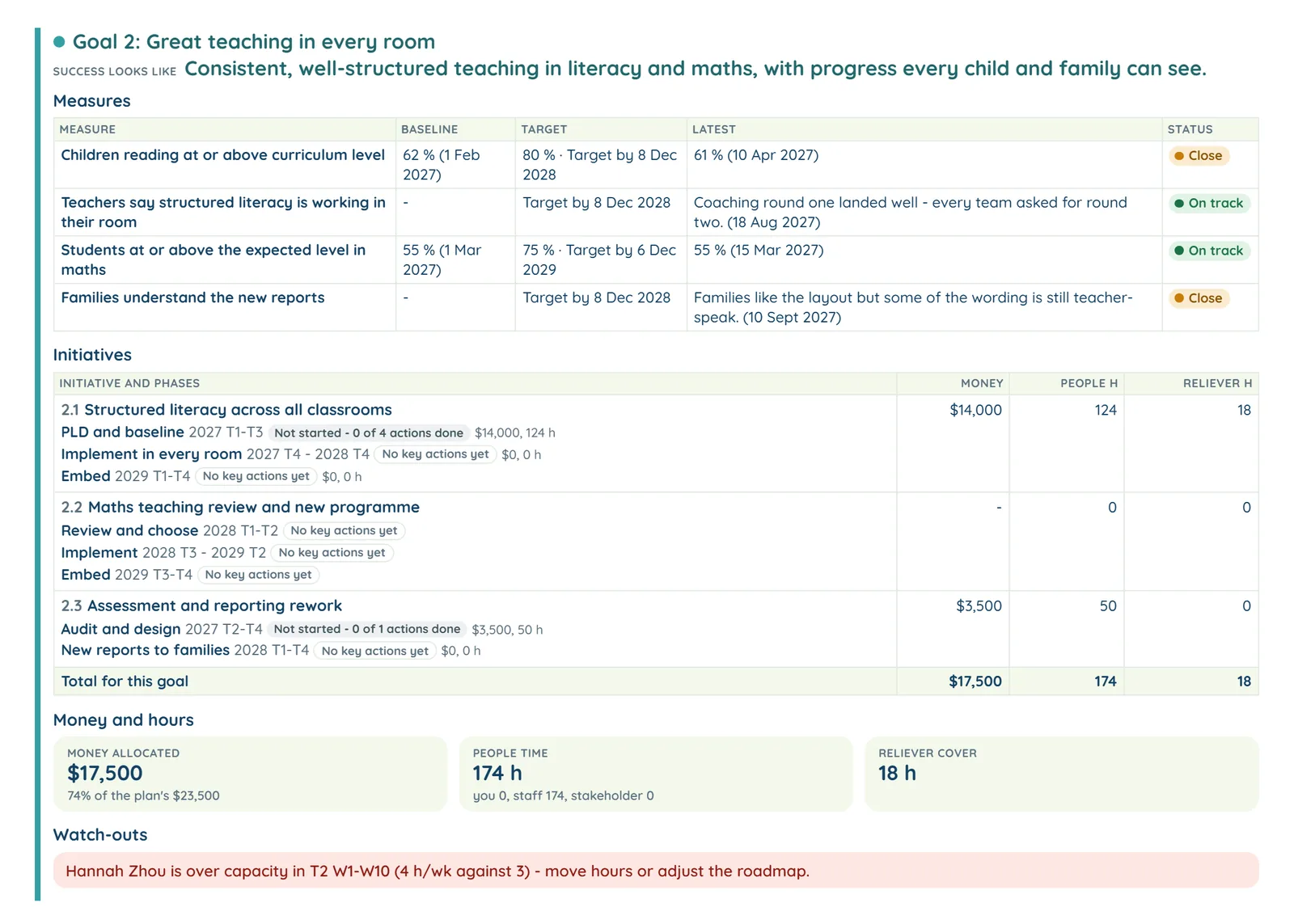
This is one goal from the Compass Point demo's Board by goal report. The measures and their lights, the initiatives, the money and the hours - and the one watch-out a board would want to hear about in November.
Who can see a plan.
Each plan belongs to the person who started it, usually the principal. They choose who else can open it - staff as editors, board members as viewers. A viewer can't change the plan. They can take their own copy of it, so it's worth sharing with the same care as any board paper.
Every login is set up by us, by invitation.
As the people who run the service, we're able to open any plan at any time, and to edit or copy it. We only do that when someone asks us for help - and we'd rather say so plainly than leave it in the small print.
Plans are kept with a hosting company, in a data centre in Sydney. The service holds the names of the people in a plan and the email addresses people sign in with.
Where it fits.
The strategy and the thinking still come from the board and the principal. Planning Room comes in after that and does the sums - can the people you've got, in the terms you've got, carry what's been agreed?
The Ministry of Education's planning and reporting framework asks every board for a strategic plan, an annual implementation plan and an annual report. Planning Room doesn't write or send any of those. It sits behind them and tests whether the year can hold what they say.
A hand with the plan
Want someone in the room for the first one?
Planning Room is built to be used without us. Some teams still want a hand to get the first plan finished and the hard conversations started. Lisa Shaw facilitates planning days for leadership teams and boards, and coaches leadership teams through the year that follows.
We think a good planning day ends with two things - a plan that's finished, and the newest people at the table owning it as much as the ones who've been there for years. So the day goes on deciding together, and very little of it goes on slides about what strategy is.
For coaching and advice that keeps going after that, there's MPower.
Or email hello@planningroom.nz