Same question, different calendar.
"Can we actually deliver this plan?" gets asked at a not-for-profit board table and in a small business on a Monday morning. Planning Room answers it the same way in both - goals, people, hours, money, and whether it adds up.
Count the hours nobody's paying for.
A small organisation's plan often runs on time that isn't on any payroll - the chair's evenings, a volunteer's Saturdays, a partner who said yes in a meeting.
Here's a check that takes five minutes. For each person in the plan who isn't paid for it, how many hours a week did they actually offer? And what does the plan quietly assume?
The gap between those two numbers is usually where the strategy doesn't get done.
Is your plan actually deliverable? The twenty-minute check (it works in quarters too)

Quarters, or two-month cycles. You choose.
One setting changes the shape of the year. Another changes the words - a leader where a school has a principal, cover where a school has relievers, the whole organisation where a school has the whole school.
Volunteers and board members have hours too.
The people who give time to a plan aren't always on the payroll. Board members, volunteers and partners can go in with the hours they really have, and the capacity check counts them like anyone else.
A report built for the board table.
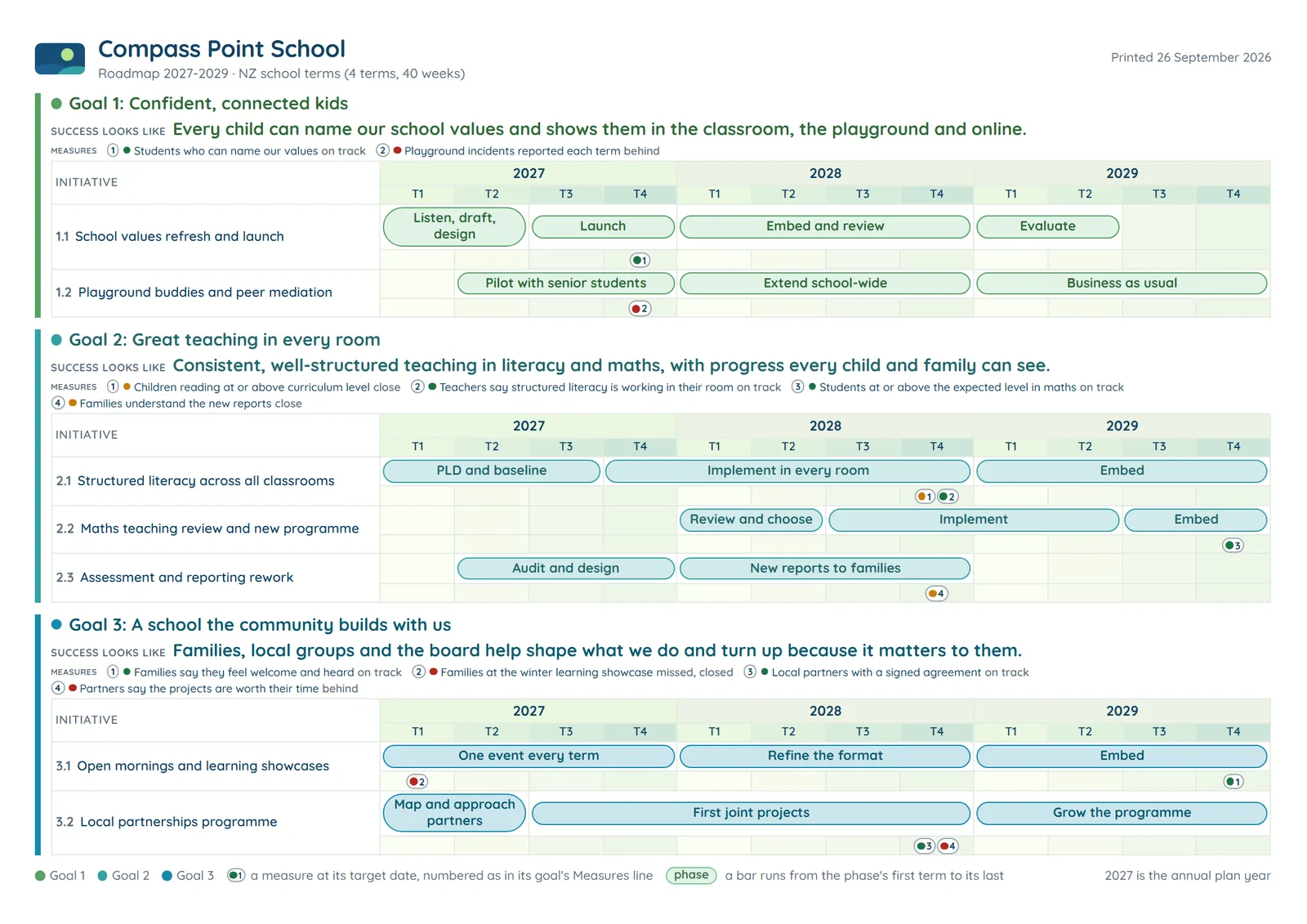
Board by goal puts each goal on the page with its measures, initiatives, money and hours, and the watch-outs. The whole roadmap prints on one page. Board members can have a viewer login and read it for themselves.
Straight up - schools came first.
The demo plan is a school, and a school is where Planning Room started. The way it works is the same for any organisation that plans in goals, initiatives and people.
The page for the board table.
The whole roadmap on one A4 page - every goal with what success looks like, its measures and its initiatives, and each phase across the years of the plan. This one is from the demo plan, which is a made-up school.
Bring the newest board member with you.
Boards change. Halfway through a plan, some of the people at the table weren't there when it was written, and it's hard to stand behind a plan you had no part in making.
The fix we'd reach for is a simple one. Get the newer members into the room when the plan gets finished - setting the hours, arguing about what comes off, putting their name to it. What helps most is a real say in this plan, far more than another session on what strategy is.
A hand with the plan
Want someone in the room for the first one?
Planning Room is built to be used without us. Some teams still want a hand to get the first plan finished and the hard conversations started. Lisa Shaw facilitates planning days for leadership teams and boards, and coaches leadership teams through the year that follows.
We think a good planning day ends with two things - a plan that's finished, and the newest people at the table owning it as much as the ones who've been there for years. So the day goes on deciding together, and very little of it goes on slides about what strategy is.
For coaching and advice that keeps going after that, there's MPower.
Or email hello@planningroom.nz