From great strategy to real outcomes.
Turn big ideas into work that actually gets done - without burning out your people.
Planning Room takes your strategic plan and puts real people, real hours and real money against every initiative. So you can see what's doable before the year starts - and nobody gets quietly buried in Term 2.
Try this first. It takes five minutes.
Grab your annual plan and a pen. Every time a name sits beside an action, give that name a tick.
Now ask two things. Who has the most ticks? And how many hours a week does that person really have for this work, once the teaching, the parents and everything else are done?
If it's the same three or four people (it usually is), you've just found where your plan will stall.
The goals are rarely the problem.
In our experience the goals are good. The trouble turns up in Term 2 (or the second quarter, outside a school), when the same few people are carrying most of it and nobody's added up their hours.
We built Planning Room to do the adding up first - while there's still time to move something, drop something, or ask for more.
We'd rather know in November than in May.
This is a line from the demo plan, word for word.
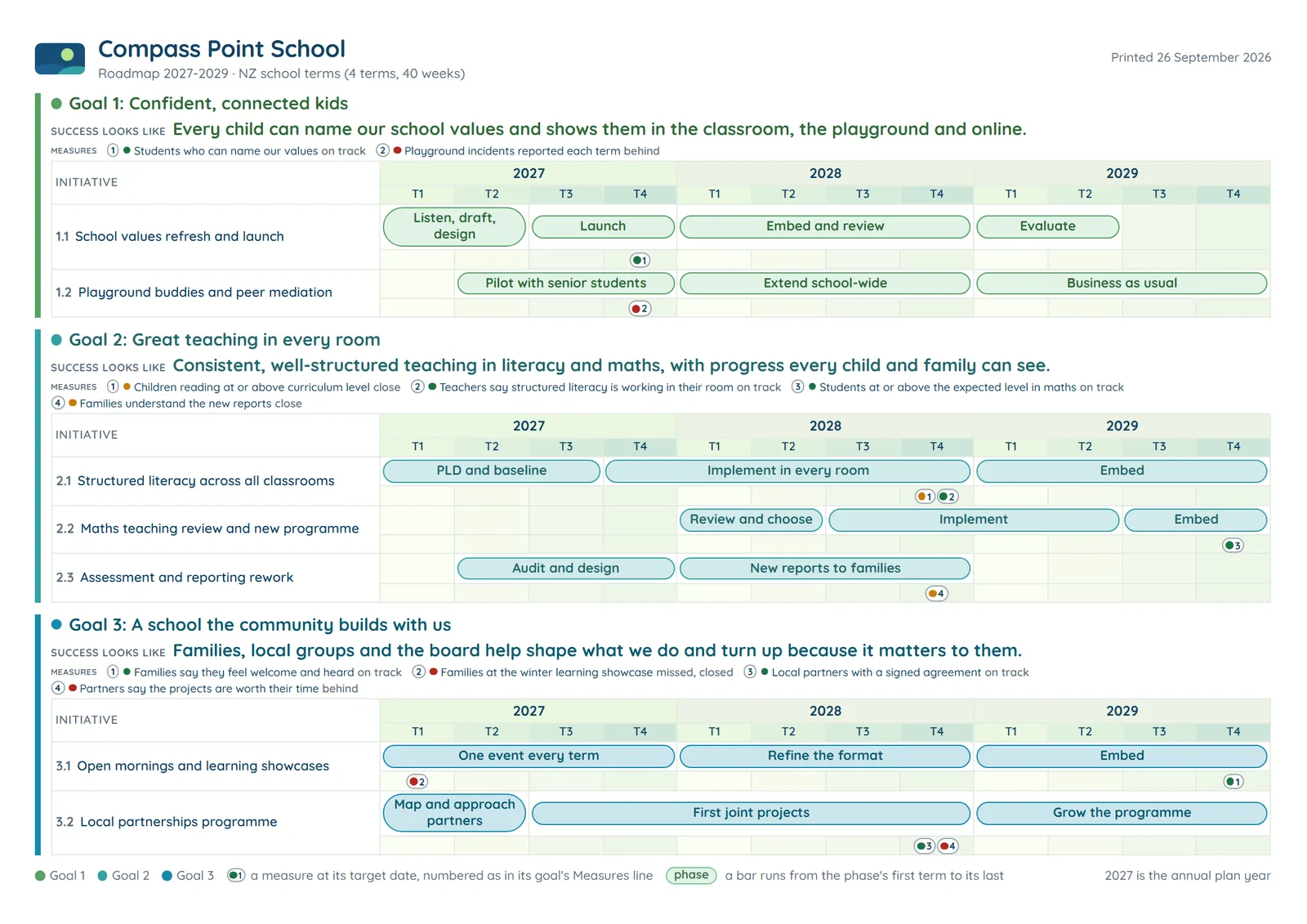
Over capacityHannah Zhou is over capacity in T2 W1-W10 (4 h/wk against 3) - move hours or adjust the roadmap.
Hannah is the literacy lead at Compass Point School (made up, like the school). She has three hours a week to work on strategic priorities. Term 2 asks for four - three for the literacy programme and one for advice on the assessment audit, all ten weeks. One hour a week. Small on paper. Too often that conversation happens in May, when Hannah is already tired and the term is half gone. Put it on the screen in November and there are still real choices - move the hours, share the load, add cover, or take something out of the year.
Nobody decided to overload Hannah. Each job looked fine on its own. It was the adding up that was missing.
From the big goals to who's doing what in week six.
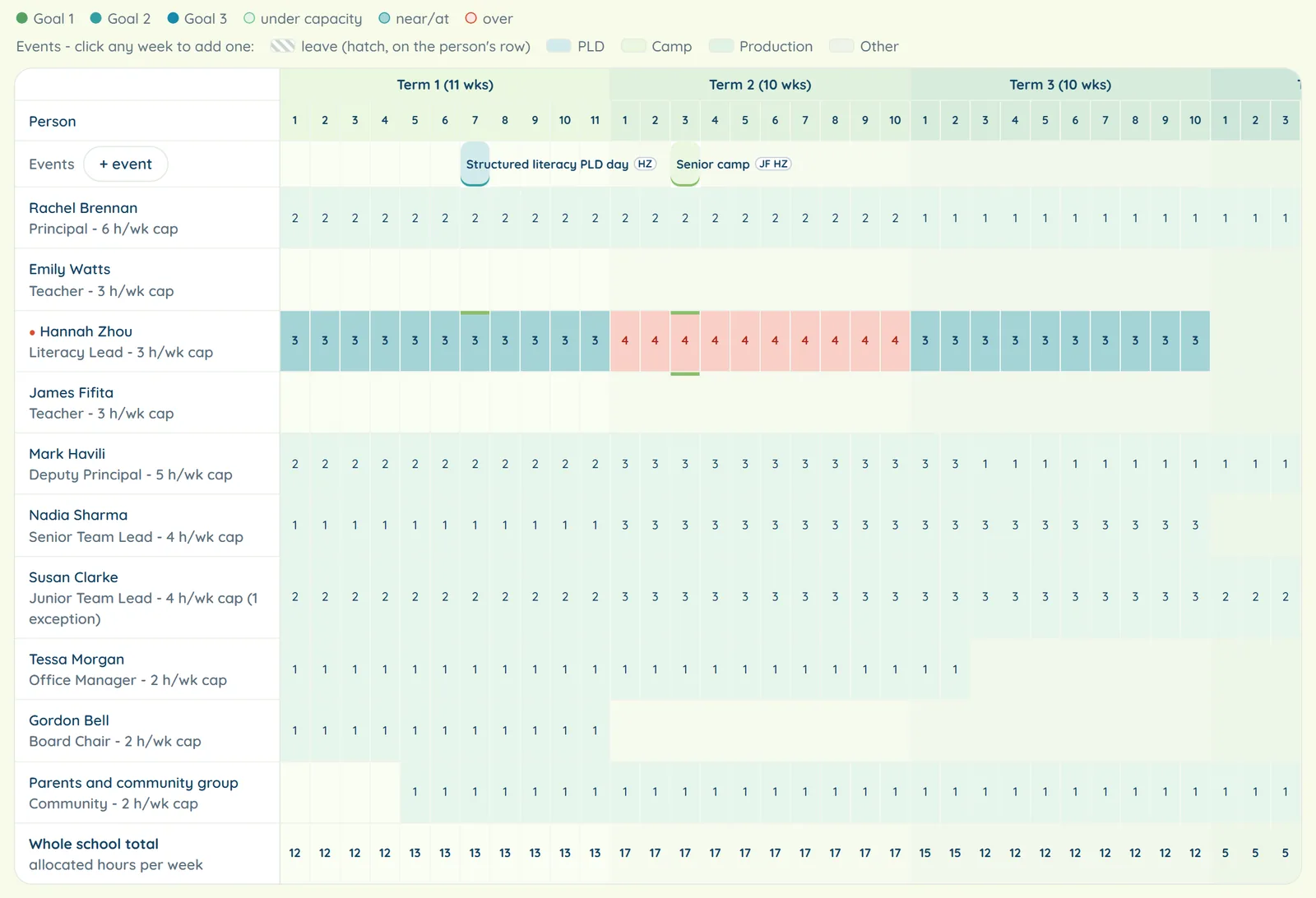
A roadmap on one page
Every goal, initiative and phase, across the years of the plan. It prints on a single A4 landscape sheet, which is the page that goes in the board pack.
An annual plan with names on it
Each phase can carry its key actions, one person accountable, the people responsible, the dates, the money, and the hours for each person.
A capacity check in plain words
Hours add up week by week, for every person and every team. When someone's over, it says so - who, and which weeks.
Measures that show how it's tracking
A target date and the actuals as they come in. A number measure carries a baseline and a target. Each one shows a red, amber or green light.
Three ways in, and the first two don't need a login.
Read the check.
A twenty-minute way to see whether a plan fits the people named in it. Pen and paper.
Try it on one person.
The capacity check is a free download, and there's no form in the way.
See it with a whole plan.
Every trial opens with Compass Point School, a made-up school with a full plan in it.
Built for schools first. Made for anyone with a plan and a board.
For schools
It talks like a school from the first screen - terms, a principal, reliever cover, and a roadmap the board can read on one page.
For schoolsFor boards and small organisations
Set the plan up for an organisation and the words change - a leader, cover, the whole organisation. Quarters or two-month cycles are one more setting.
For boards and small organisationsWho's behind it.
Lisa Shaw built Planning Room. She has over 20 years of governance experience, has been on a school board (including as Board Chair as it was back then), and she facilitates planning with school leaders.
One annual planning workshop she ran for school leaders, in 2023, scored a Net Promoter Score (NPS) of 95 - the top score in the country for that workshop.
Two reports, and nothing to fill in.
One report is for the people running the year, and one is for the board table. Both come straight from the plan, and both print exactly as they look on screen.
Operations by term
For the principal and the leadership team. Term by term, it shows what is running, what is due, what is booked and what has been spent. Nobody types it up - it builds itself from the plan.
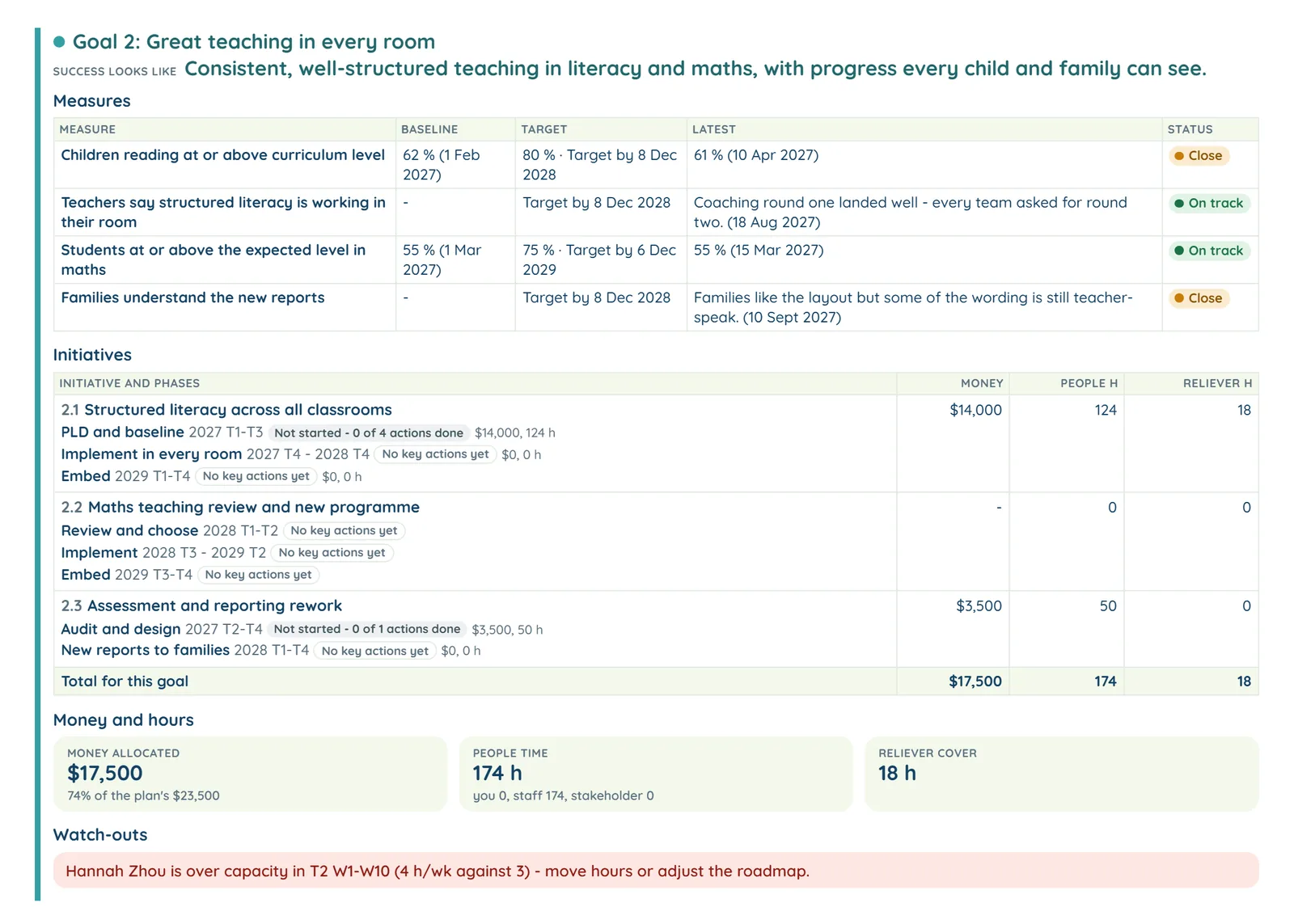
Board by goal
For the board. Every goal sits on the page with its measures and their red, amber or green lights, its initiatives, the money and the hours against it, and the watch-outs - the things a board would want to hear about in November, not in May.
We don't call people resources.
In Planning Room the tab says Capacity and the page says Allocate time. What's being spent is people's time, and we think a plan should talk about it that way.
People are the reason an organisation succeeds, not a line item. A resource gets used up. A person gets asked.